
mprove our understanding of you. You can unsubscribe at any time.
In an era where the global political architecture of our world is being reshaped and the new multipolar world order is further deepening, states are pursuing multi-vector foreign policies to secure their interests and strengthen their positions in the international arena. The new technological challenges created by the Fourth Industrial Revolution and the changing balance of economic and political power make it necessary for countries to conduct a more flexible and comprehensive foreign policy. In this context, the relations that the Republic of Azerbaijan has maintained with European countries in recent years—including the United Kingdom of Great Britain and Northern Ireland—always based on mutual respect and trust, carry a special strategic significance.
In general, relations between the Republic of Azerbaijan and the United Kingdom have been built on strategic interests and unshakable partnership principles since the very first days of our independence history. The UK, which was one of the first states to recognize our country's state independence on December 26, 1991, has always provided great support to Azerbaijan's sovereignty and economic revival.
High-level cooperation exists between the Republic of Azerbaijan and the United Kingdom in various fields, including ongoing political dialogue, a strong economic agenda, and intensive cultural and educational exchanges.
The brightest page of this cooperation was opened with the "Contract of the Century," authored by National Leader Heydar Aliyev and signed in 1994. The role of British companies in the implementation of that historic oil agreement—especially British Petroleum (BP), which acted as the main coordinating operator—is undeniable. In addition, British experience and cooperation made an important contribution to the process of establishing the State Oil Fund of the Republic of Azerbaijan (SOFAZ) with the aim of transparently managing oil revenues and preserving them for future generations, as well as to its institutional development.
As a logical continuation of the consistent policy pursued, during President Ilham Aliyev's official visit to the UK in 2018, with the participation of Prime Minister Theresa May, the signing of a new agreement on the joint development and production sharing of the "Azeri-Chirag-Gunashli" fields—in other words, the extension of the oil agreement—strengthened the energy partnership between the two countries until the middle of the 21st century.
I should note that over the past period, the United Kingdom has invested $34 billion USD into the Azerbaijani economy, which accounts for approximately 50% of all foreign investments made in Azerbaijan.
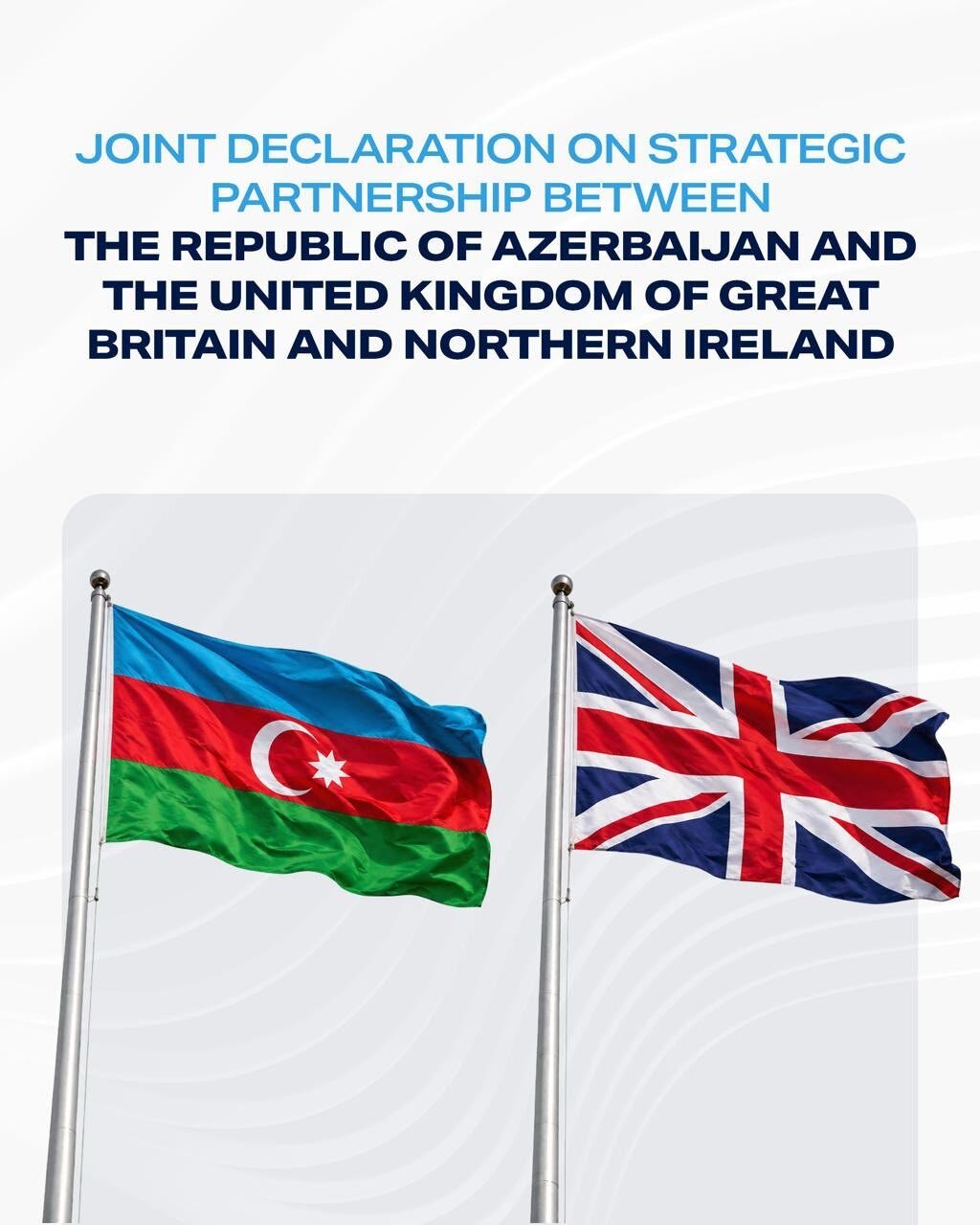
Overall, more than 25 documents have been signed between the two countries to date. Recently, upon this deep historical foundation, our bilateral relations have entered an entirely new qualitative stage: a Strategic Partnership. The "Joint Declaration on Strategic Partnership," signed by the President of the Republic of Azerbaijan, Ilham Aliyev, and the Prime Minister of the United Kingdom of Great Britain and Northern Ireland, Andy Burnham, on November 12 of the current year in Dublin within the framework of the 9th Summit of the European Political Community, became a new turning point in the history of interstate relations. Remaining loyal to the spirit of the "Joint Declaration on Friendship and Cooperation" dated February 23, 1994, and the "Joint Declaration on Friendly Relations and Partnership" dated July 21, 1998, this document can also be called a comprehensive roadmap responding to modern global challenges.
The political and international legal significance of the Declaration is a point worthy of special attention. Thus, the reaffirmation in the document of the principles of the UN Charter, the inviolability of internationally recognized borders, sovereignty, and territorial integrity is an indicator of the high value given to Azerbaijan's principled position. At the same time, the mention in the Declaration of the importance of the Washington Declaration dated August 8, 2025, the welcoming of peace steps taken towards the normalization of relations between Azerbaijan and Armenia, and the United Kingdom's consistent support for sustainable peace in the South Caucasus are extremely important in terms of our region's future security.
The document defines three main strategic directions for bilateral cooperation: Defense and security; Trade, investment, and the green energy transition; Education, science, and digital transformation.
First of all, both countries are expanding joint initiatives in the fields of the defense industry, training, and capacity-building to protect regional stability and neutralize common threats. Deepening the partnership in law enforcement, border management, and judicial-legal areas serves institutional resilience and the rule of law.
At the same time, moving beyond the traditional oil and gas sector, renewable energy, green financing, and the development of SMEs are becoming key priorities. Support for the development of the Middle Corridor and regional transport and logistics connectivity further strengthens Azerbaijan's role as a major transport hub of Eurasia.
Finally, the inclusion in the document of provisions regarding the expansion of ties between universities and research institutes in the fields of higher and vocational education, artificial intelligence, digital governance, and life sciences as the foundation of a competitive economy, as well as the promotion of inter-community and interpersonal exchanges, opens up great opportunities in the field of science.
Thus, the reliable energy partnership tested by the "Contract of the Century" for over 30 years has today transformed into a comprehensive Strategic Partnership covering defense, the green economy, transport connectivity, and high technologies. The signed Declaration will serve both the well-being of the peoples of the two countries and the strengthening of peace and security in the South Caucasus as a whole.